
Beyond Imperial Statutes: Reimagining Equity in Post-Colonial Jurisprudence
In my last piece, I talked about how we were dealt a bad hand of cards and why. But now that we’ve diagnosed the problem, we need to move toward solutions. Decoding a system isn’t the same thing as dismantling it. While our legal foundations were set up for us, we have to build on them, adapt them, and tailor them to the actual needs of our nations, just as many are already beginning to do.
So, if the blueprint is flawed, how do we code it? My conviction is that this goes far beyond structure; it is a fundamental mindset. To live in a version of the law that actually serves us, we have to decolonize our minds first. As Ngũgĩ wa Thiong’o famously put it in Decolonising the Mind, “imperialism’s most important area of domination was the mental universe of the colonised, the control, through culture, of how people perceived themselves and their relationship to the world.”[1] Restructuring the system requires unlearning the idea that authority must always look European.
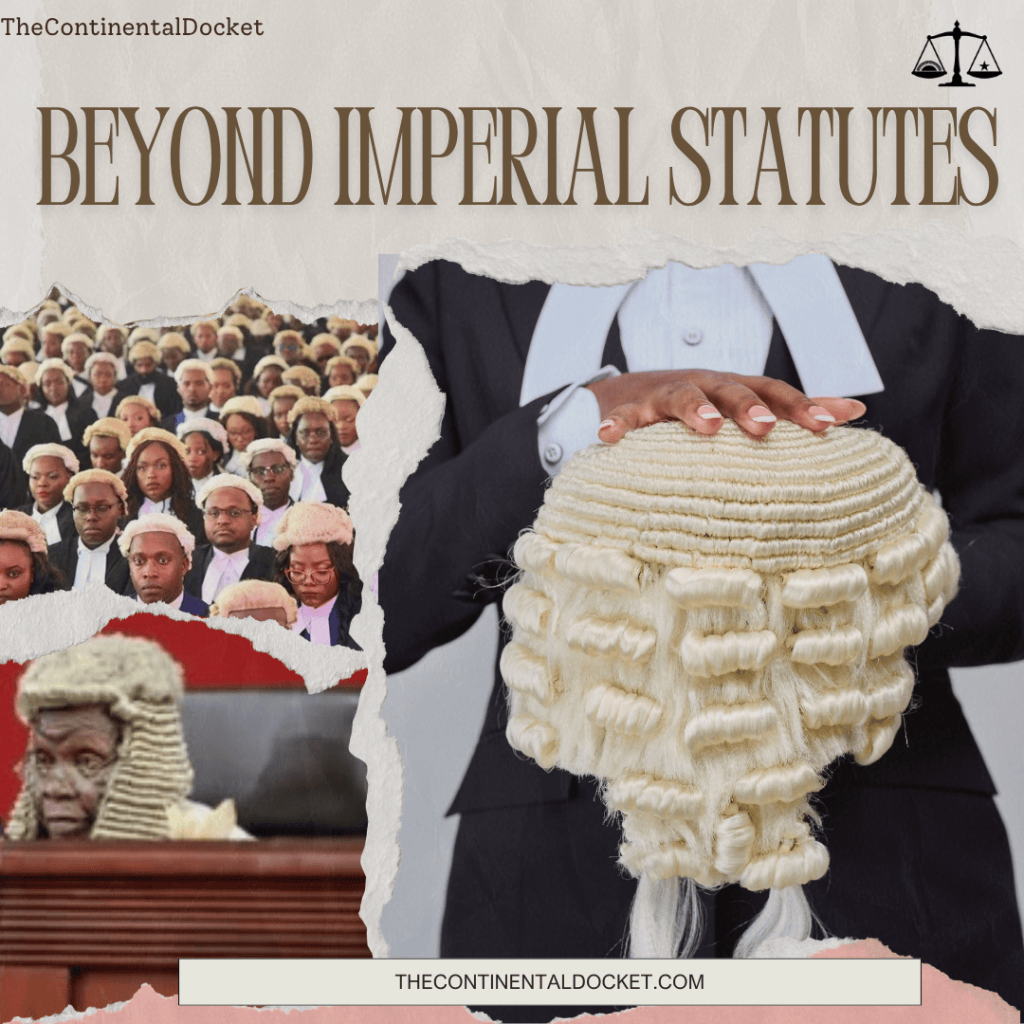
Look at Uganda. The Uganda Law Society recently banned lawyers and litigants from addressing judges with colonial-era titles like “My Lord,” “Your Lordship,” or “Your Worship,” while dispensing with mandatory bowing and formal court attire. In places like Uganda and Malawi, lawyers are increasingly questioning the point of wearing heavy horsehair wigs and black robes designed for European winters.[2][3]
Why are we still wearing them? For many, the conversation has shifted away from why these items were created and floats instead around status, the pride one feels wearing them despite the sheer lack of comfort. It is almost impossible to imagine a symbol carrying that same global weight without colonial enforcement. Even when we try to disassociate, these wigs and robes act like ghosts of the colonizers. They defeat the purpose of everything our people fought for during independence. They hold no native cultural significance; people continue to wear them simply because they were never told to stop. It isn’t about respect. And if it isn’t about respect, why do we hold onto it?[4]
This piece isn’t just about wigs and robes. It is about the significant weight of changing foundations and adapting inherited structures.
We have statutory laws governing our countries, but there is a massive disconnect with reality on the ground. Take a young person who grows up in severe poverty and commits a petty crime, like an orphaned street child with no means to survive. Statutory law defaults to detention, but the real issue runs much deeper. While Western jurisdictions like the UK modernized their youth justice systems over time, moving toward trauma-informed care and mental health evaluations, many post-colonial African statutory frameworks remain frozen in mid-20th-century colonial legislation. Zambia’s statutory guide, for instance, remains the Juveniles Act of 1956, modelled on the English Children and Young Persons Act of 1933.
These statutory frameworks treat youth delinquency through a rigid, retributive penal lens. Urban formal courts, lacking state-funded mental health diversion programs, process young offenders through adversarial procedures that default to detention, remaining blind to systemic poverty and developmental trauma.
Where state statutory systems fail, community-based customary law often steps in to fill the void. In rural Zambia, customary systems treat juvenile wrongs not as criminal acts deserving cold incarceration, but as disruptions of community harmony. The goal is restorative: family arbitration, making the offender understand their impact, and requiring caregivers to repair the harm. For pre-pubescent youth, customary law views the child as an object of care rather than a criminal subject. There is undeniable power in this restorative approach, especially in communities navigating immense poverty, where customary pre-colonial solutions feel far more aligned with daily social realities than imported statutory codes.[5]
This brings to mind The Brothel Boy, a legal parable penned by criminologist Norval Morris, drawn from George Orwell’s time as an imperial magistrate in Burma. In the story, an uneducated, impoverished local boy commits a violent crime inside a brothel. The formal colonial court processes him through an unyielding statutory machine, completely blind to his total lack of comprehension, his deep poverty, or his mental state. It is a chilling mirror for the modern post-colonial courtroom: an unfeeling administrative engine designed to punish the symptoms of systemic distress without examining the human context behind them.
Yet, as Morris highlights, colonial magistrates constantly wrestled with the friction of trying to respect local culture while addressing hateful crimes. And this is where my critique comes in.[6]
There are serious limits to customary restorative justice.
Just like the horrifying crime committed in The Brothel Boy, we cannot let “restorative justice” hide severe harm. I have seen situations where women and children are subjected to abuse and violence, only for families and local elders to protect the perpetrator under the guise of “restorative justice” and “community harmony.” I fundamentally disagree with this. People who are subjected to abuse should never be forced to forgive, negotiate, or make amends with their abusers.
The difficulty is that you cannot cherry-pick elements of customary law based on personal preference, it operates as an interconnected cultural system. In small, patriarchal community structures, vulnerable individuals lack equal bargaining power against abusers. If customary law insists on mediation for everything, it risks replacing formal statutory rigidity with informal, institutionalized protection for perpetrators.
This is where the late Chief Justice Pius Langa’s vision of Transformative Constitutionalism offers a vital path forward. In his historic 2006 lecture, Langa envisioned South Africa’s Constitution as a “historic bridge” away from an unjust, divided past toward a future rooted in human rights and substantive equality.
Crucially, Langa called for a shift in legal culture: moving away from a “culture of authority” (blind obedience to colonial statutes, rigid rules, and archaic courtroom props) toward a “culture of justification” (where every exercise of power must be substantively justified by constitutional human rights and social reality). He explicitly warned against a conservative legal culture that hides behind technicalities instead of engaging with the actual social fabric.
Applying Langa’s framework resolves the tension between statutory and customary law. True decolonization does not mean scrapping statutory law entirely or retreating blindly into traditional practices. It requires a hybrid, constitutional model.[7]
For youth delinquency and minor community disputes, restorative customary mechanisms, like Sierra Leone’s Child Panels or South Africa’s Child Justice Act, offer child-friendly, culturally relevant diversion channels that avoid the cold trauma of statutory detention. But for severe crimes, physical abuse, and gender-based violence, statutory jurisdiction and constitutional rights must remain absolute to protect individual dignity from forced communal reconciliation.[8]
De-centering the colonial blueprint isn’t about burning down the courthouse;
It isn’t just about ditching the wigs and the robes. it is about reshaping what happens inside it. It means adapting our legal systems, so they are tailored to our culture, our people, and our realities, not just in statutory policy, but in our appearance, mindsets, and most importantly, our identity.
[1] Ngũgĩ wa Thiong’o. (1986). Decolonising the mind: The politics of language in African literature (p. 18). James Currey
[2] BBC News. (2024). Uganda judges push back against lawyers’ bid to scrap ‘colonial titles’. https://www.bbc.co.uk/news/articles/cwydzr9p1geo
[3] The Guardian. (2012, October 3). Bring down the African big wigs. https://www.theguardian.com/world/2012/oct/03/malawi-uganda
[4] Nyawa, J. M. (2017, November 30). David Maraga: Haunted by who? Haunted by the ghost of colonialism. Social Science Research Network. https://papers.ssrn.com/sol3/papers.cfm?abstract_id=3078741
[5] Kapianga, K. (2021). Reclaiming the delinquent child: A proposed framework for a customary law-based child justice system in Africa using Zambia as a case study. African Human Rights Law Journal, 21(1). https://www.scielo.org.za/scielo.php?pid=S2663-323X2021000100009&script=sci_arttext
[6] Morris, N. (1992). The brothel boy and other parables of the law. Oxford University Press. https://doi.org/10.1093/oso/9780195074437.001.0001
[7] Langa, P. (2006, October 9). Transformative constitutionalism [Prestige lecture]. Stellenbosch University, South Africa.
[8] Leao, I. (n.d.). An analysis of specific laws concerning youth crime and associated procedures for juvenile delinquency: The Sierra Leone case under the framework of international law. Academia.edu. https://www.academia.edu/3586339/An_Analysis_of_Specific_Laws_Concerning_Youth_Crime_and_Associated_Procedures_for_Juvenile_Delinquency_The_Sierra_Leone_Case_Under_the_Framework_of_International_Law


Leave a comment